
Introduction
I would like to begin this concluding essay by thanking the previous contributors of this Theopolis Conversation. Each respondent has addressed the topic of the obscene realm from complementary angles. Each has also helped me direct and sharpen my thoughts on the topic. This leaves me grateful for a multitude of counselors and friends.
In one sense, I am surprised at the lack of pushback to my proposal, especially in light of how much tension that discussions such as these engender. But since the contributors to this series are also devoted to honest and unabashed readings of the biblical text and its language, lack of pushback is expected. In addition, I think that what I suggested in the initial essay is not all that radical. The proposals I offered follow the biblical text closely and accurately. Even if researchers and academics disagree on any particular point, what I suggest is in-line with standard interpretations found in lexica, dictionaries, commentaries, and so on.
From those who do push back against the Christian use of profanity, vulgarity, or dysphemism, there seems to be a recognition that the Scriptures may talk that way, and there is a place for this kind of speech in the Christian life—but where? who models such prophetic speech well? So, I ask, why don’t we see positive examples from those who, on the one hand, dismiss Wilsonian rhetoric while, on the other hand, praise biblical speech? Until examples of a contemporary who does it the right way (like Ezekiel!) can be provided, I’m tempted to say that such dismissals are wanting and either uninformed or disingenuous.[1] But this kind of euphemistic caution is pervasive in the history of biblical interpretation and reception. It is something we have to live with and get used to. Two examples of such tendencies follow, one contemporary and one from antiquity.
Tendencies of Euphemism
First, this intentional euphemistic impulse seems to occur in the arrangement of Psalm 3 in The Sing! Hymnal that Crossway recently published.[2] Although the Psalm is arranged with English meter and rhyme-scheme in mind, it nonetheless transfers the full range of content from the original. However, when David calls for God to punch his enemies in the jaw and shatter their teeth in verse 7, the Hymnal deviates from its consistent pattern of content transfer:
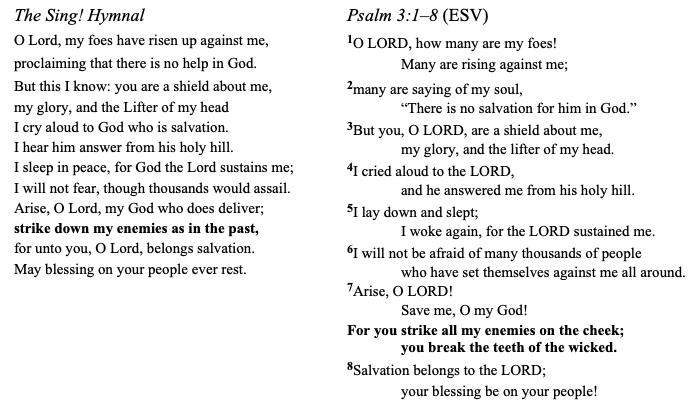
The hymnal omits key terminology, opting for the softer rendering of “strike down my enemies as in the past” instead of the textual cheek-striking and teeth-breaking. The editors transfer the content of every other line of this Psalm with precision, but when we come to something harsh and shocking, like God engaged in bare-knuckle boxing, the hymnal intentionally excludes it. Could this omission originate from difficulties of composition, arrangement, rhyme scheme, spacing, and meter? Perhaps. But I suspect it occurs because of a more general tendency to distance our speech from harsher Scriptural speech.
Is the way of speaking modeled in Psalm 3:7 ungodly? Is it somehow unworthy of corporate singing? If not, then why omit it? This way of speaking is in fact the very reason that David can sleep soundly without fear of his enemies. If you mess with David and become his enemy, God will wake up and break your jaw so that David doesn’t have to. That is the very salvation and blessing that God provides for his people.
Jeremy Bennett helpfully reminds us that the entirety of the Torah of Moses was to be read during the Feast of Booths, out loud, in public, in the ears of all Israel. This includes men, women, children, and sojourners: “Even the yucky and blushy parts.” This includes even the vulgar covenant curses of Deuteronomy 28:15–68. And why does Moses command this? Because it produces the fear of YHWH and a life of godliness in his people (31:12–13). This needs to be retrieved rather than avoided. The example from the Crossway hymnal above seems to depart from the example set forth in Deuteronomy. If we can’t read, sing, hear, or write(!) what the Bible itself says and how it says it, how can we expect to have a tota biblia approach to the Christian life? How can we expect to be godly and mature? What you liturgize people with is what you liturgy them into.[3]
However, this tendency toward caution and euphemism is not uncommon in the history of interpretation. Reading, transmitting, interpreting, and translating the Bible has a long pedigree of imposing euphemism on the text. This is understandable since, while the Scriptures often employ harsh and vulgar expressions, the literature is replete with euphemistic expressions as well.
As I mentioned in my opening essay, the Ketiv-Qere tradition conveys aspects of this euphemizing tendency in the history of interpretation and reception. Recall that the reading tradition of the Hebrew Bible (called the Qere) diverges from the written tradition (called the Ketiv) in certain key places in order to avoid such profane language. In such instances, the euphemistic Qere occurs not in the consonantal text itself but in the marginalia, which guides public reading. This euphemistic tendency, however, is not an innovation of late antiquity (i.e., the Masoretic Text), but instead goes back to our earliest evidence from translated versions of the Old Testament that predate the Masoretic textual tradition by somewhere between 400–800 years.
My second example to illustrate this tendency concerns the story of the travelling, plague-causing ark in 1 Samuel 5:1–12. This story provides evidence for the antiquity of this euphemistic tradition which precedes Masoretic marginalia. When the Philistines brought the ark of YHWH to Ashdod, Gath, and Ekron, the god Dagon fell, men died, and “tumors” afflicted the survivors. The rendering of עֹפֶל as “tumor,” however, is euphemistic in both modern and ancient translations as well as in the Ketiv-Qere tradition.[4] Whereas the Hebrew consonantal text contains the term עפלים in this story, the Masoretic marginal notes suggest a more socially acceptable reading of יְחֹרִים “ulcers of the anus, hemorrhoids, boil.”[5] Take note that this latter meaning is the euphemistic one. This means that the dysphemism of consonantal text is even more uncouth.[6] Have you ever heard even the euphemistic terms read aloud in church? I suspect that even the euphemism is too much for most people. Let the reader, then, imagine the more accurate meaning.
Since the Hebrew text itself was considered harsh or obscene[1] , the ancient versions and translations illustrate in various ways a longstanding tendency toward euphemism in meaning. The Samaritan Pentateuch (⅏) preserves the term עֹפֶל in its occurrence from Deuteronomy 28:27, which in turn illustrates the antiquity of the Hebrew consonantal text. However, every other version preserves a softened euphemism for this term. The Aramaic Targum (𝔗) contains the euphemistic root טחר in every instance. Likewise, the Syriac Peshitta (𝔖) employs the same root ܛܚܘܪܐ “hemorrhoid” and also ܚܘܛܪܐ “rod” in one example.[7] The Latin (𝔘) tradition employs the terms nātis “the rump, buttocks,” extālis “the straight gut, rectum,” and anus “posterior, anus, hemorrhoid.”[8] Finally, the Septuagint (𝔊) contains the most striking euphemism in the tradition as it departs from anatomical imagery entirely. The translators consistently employ the term ἕδρα “sitting” to indicate that the Philistines were afflicted with sitting down. Aquila also preserves this Septuagintal reading, while Symmachus renders the term with the euphemistic κρυπτός “hidden, secret.”
What this evidence suggests is that the tendency toward euphemism is natural for and pervasive among the people of God. When it comes to altering how we read the biblical text, I can’t say it’s praiseworthy. I get it. I’m just not sure it’s appropriate. But there’s hope against this overly-euphemistic tendency in biblical interpretation. One final example illustrates how the tradition of biblical interpretation and reception is marked not only by euphemistic softening. Occasionally, we see the reverse.
Retrieving Euphemistic Dysphemisms
In the well-known passage from Deuteronomy 25:11–12 regarding the wife who interferes with her husband’s physical quarreling, we encounter a dysphemism in the translation tradition that moves away from euphemism. This example illustrates well both the range of such euphemisms in the Hebrew Bible and in the ancient versions, and also how departure from euphemisms occur in the tradition:
When men fight together, a man and his brother, and a wife of one draws near
to rescue him from the hand of the one striking him, and she stretches out her hand,
and she seizes “his shameful parts” [וְהֶחֱזִיקָה בִּמְבֻשָׁיו] (=genitals)
you shall cut off her hand; your eye shall not pity.
In this passage, the Hebrew text contains the nominal מְבוּשִׁים from the root בושׁ “to be ashamed.”[9] It should at minimum be regarded as evocative of the male reproductive organs. And as Tov notes, the use of this term is already presented euphemistically in the Hebrew text itself.[10] In line with this pattern, the ancient versions also present this term euphemistically:
⅏ ושלחה את ידה והחזיקה בבשרו
“and she would send out her hand and would seize his flesh”
𝔗[11] ותפשׁוט ידה ותתוקף בבית־בהתתיה
“and she stretches out her hand and seizes his private parts”
𝔖 ܘܬܘܫܛ ܐܝܕܗ݁ ܘܬܐܚܘܕ ܒܚܢܗ
“and she stretches out her hand and seizes his private parts.”
𝔘 et adprehenderit verenda eius
“and she would seize his private parts”[12]
The Samaritan Pentateuch employs euphemistic semantics with the more generic בָּשָׂר “flesh.” And the euphemistic reading of the Vulgate derives from the verb vereor “to revere, respect.” The Targum and Peshitta read similarly. Each of these versions pick up on the Hebrew euphemism and seem to soften the harsh referent further.
However, as we consider the Greek rendering of מְבוּשִׁים in the Septuagint, we notice that translator appears to move in the opposite direction by unveiling what the Hebrew text actually referred to by its in-built euphemism:
𝔊[13] καὶ ἐκτείνασα τὴν χεῖρα ἐπιλάβηται τῶν διδύμων αὐτοῦ
“and stretching out the hand, she would take hold of his twins”
By employing the term “twins” to represent the Hebrew “shameful parts,” the Greek translator seems to have picked up on the euphemism of the Hebrew and has chosen a term that explains it in more detail. And while this euphemistic sense of δίδυμος ִis not unattested in Greek literature, it is not the typical meaning conveyed by use. The Greek language has plenty of terms to describe this aspect of male anatomy.[14] But the translator chose something creative. And even though the Greek translator departs from the euphemistic, he doesn’t side with the vulgar. Instead, he produces a clever and comedic semi-euphemistic rendering which captures the sense of the Hebrew text without being crass. This seems to be in line with how the Bible employs euphemisms more broadly. Biblical euphemism makes you stop and ponder until you get to that “ah-ha!” moment.
I think the Septuagint rendering here can serve as a model for us in our speech as we seek to speak about the world in its harshness. We should be clever and creative. Our words should leave clever overtones in the air for those with the sensibilities to pick up on them. Twins. You get it? This kind of euphemistic dysphemism should be a part of Christian discipleship.
Conclusion
Brad Green’s observations from his essay help us think through whether or not the “vulgarities” and “obscenities” should in fact be labelled as such. This is a fantastic point and raises methodological questions regarding the precise definitions of dysphemistic Hebrew terminology. How do we know that some word evoking illicit sexual acts or bodily excretions was as obscene as an equivalent term in our language? I’m not sure we can with certainty. But by analogy, we can understand that there are socially and culturally unacceptable terms, which in the history of interpretation and manuscript tradition become problematic in public reading. This is a strong indication, not only that the terminology is harsh, but that it is so harsh that we could catalogue it as vulgar and obscene. To my mind, the Ketiv–Qere tradition is one way to access this obscene realm. But it can also be accessed by looking at the history of interpretation more generally, either in ancient Bible translation or in contemporary hymnody.
So, where should we start in our practice-makes-perfect approach to the Christian life as tota biblia? We should listen to Wilson’s reminder that it takes training. Practice makes perfect. And in context, it is something that belongs to those in the leadership role of elders. But a good place to begin should be in the regular practice of simply reading, hearing, reciting, and singing exactly what the biblical text says, from broken jaws, hemorrhoids and sores, to the full list of so-called off-colored portions of the Bible. But this must also include the full-embodiment of Philippians 4:8: the Christian heart, mind, and tongue is to be marked by what is true, honorable, just, pure, lovely, commendable, excellent, and praiseworthy. As Roberts notes, “To the degree that the fear of the Lord is lacking or weak among us, we will also be unfit to speak rightly of the obscene.” And if we are unfit to speak of the obscene, we are also unfit to speak vulgarity, obscenity, and the rest.
But if we can’t read even the Scriptural dysphemisms out loud in accurate translation, we have to repent from opposing God’s model for tota biblia. Start speaking like the Bible by reading what the text says without apology, cautions, or trigger warnings. The biblical writers and characters don’t apologize for harsh, uncouth, and dysphemistic speech. I see no reason for us do so either. However, these authors and characters are also fully formed[2] , mature, and have the proper heart posture to speak in such a way. And this latter aspect, I fear, is greatly lacking in our day. To conclude with Roberts’ remark: “[I]t is only as we become a people marked by the positive and healthful practices of speech the Scriptures enjoin that we will be able to speak these other words, words important in their place, appropriately.”
Matthew J. Albanese (DPhil, University of Oxford) is assistant professor of Biblical Studies at Union University in Jackson, TN. His primary research interests include the literatures, languages, and textual histories of the Hebrew Bible and the Septuagint. He is the author of the recent SBL Press monograph, Translation Technique and Literary Structures in Greek Isaiah 13:1-14:2.
NOTES
[1] While several figures could be referenced, in my previous article I mentioned Burke, DeYoung, and Ortlund. References to their comments can be found therein.
[2] The Sing! Hymnal, ed. John Martin et al. (Crossway, 2025). The volume is beautifully designed, typeset, and printed. It is worth owning and using as well. The only reason I know of this example is because I use this hymnal at home and have a place for it on my shelf. Nonetheless, my criticism still stands.
[3] These omissions seem to illustrate the very thing Moses warns against in Deuteronomy 4:2; 12:32. Adding to and taking away from the word does not seem to concern textual copying and transmission. Instead, it has to do with preserving the content of instruction. From this perspective, avoiding elements of biblical literature for social decorum would seem to stand in contradiction to Moses’ instruction.
[4] This term occurs six times in the Hebrew Bible and is consistently featured with the perpetual Qere from טחר: Deut 28:27; 1 Sam 5:6, 9, 12; 6:4, 5.
[5] See HALOT 374; DCH 3.363.
[6] For a comprehensive survey of these Ketiv-Qere features, see Aaron Hornkohl, The Historical Depth of the Tiberian Reading Tradition (Cambridge University Press, 2023), 67–79.
[7] This latter reading in the Syriac only occurs at 1 Samuel 5:6 and may be due to a confusion of consonants between ḤTR “rod” and TḤR “hemorrhoid.”
[8] While some of these ancient renderings could be due to misreading or misunderstanding of the Hebrew text, the overwhelming tendency toward euphemism is evident.
[9] See HALOT 542, s.v. “genitals”; DCH 5.125, s.v. “genitals.” As noted in the lexica, see also Bauer-Leander, Heb 491i; Lacau, Noms 149.
[10] Emanuel Tov, Textual Criticism of the Hebrew Bible, 3rd ed. (Fortress, 2012), 252.
[11] Targum Pseudo-Jonathan has a slightly different reading: ותושׁיט ידה ותתקיף בבית־בהתתיה. Nonetheless, it still preserves final phrase בבית־בהתתיה with the euphemism.
[12]See Lewis & Short, 1973 B.2. verendus, –a,-um, “that is to be feared or reverenced, awful, venerable; fearful, terrible”; verenda, –orum “the private parts.” Jerome seems to have softened the term as he could have employed the following terms: testiculus, testis, polimenta, proles.
[13] The earlier euphemism re-appears in Aquila as ἐν αἰσχύναις.
[14] The common Greek term for testicles is most likely ὄρχις, -ιος/-εως. While this meaning “testicles” for δίδυμος is not unattested in antiquity, that usage is not primary. For the semantic range of δίδυμος, -η, -ον, see CGL 327: 1. (of persons) born as a twin, twin; (of a birth) of twins; 2. (of persons or things) two together, paired, twin, two testicles; LSJ, 422: 1. double, twofold; 2. twin; 3.a. twins; b. the testicles; c. ovaries. For the gloss “testicles,” LSJ references LXX Deut 25:11; AP 5.125 (Phld.); sg., Herophil. ap. Gal. UP 14:11.