
As we saw in Part 1, Cain and Abel, representing an Adamic clan of many people, brought gifts to Eden’s gate to offer them to God on behalf of their family.
2.1 Gifts Received and Rejected
Cain’s gift is a harvest of the ground; Abel’s is the firstborn of the flock with its fat portions. Cain offers first, and then Abel “also brought” his gift.[1] This is an important clue that we will consider shortly.
YHWH looked on Abel and his gift, but on Cain and his gift he did not look. The impression we get is that God would not even countenance Cain, the person or his offering. Why does God reject Cain? Commentators have proposed a number of explanations:
- Abel’s heart was right, and Cain had a heart problem.
That this is a matter of the heart is clearly true as far as it goes. YHWH looks not only on Abel’s gift, but upon Abel. God receives Abel himself along with the gift he brings. But, by the same token, there must be more to it, since we can just as easily note the opposite: that YHWH looks not only on Abel the person, but also upon his gift! There is something about Abel’s gift that is congruent with his piety toward God, while Cain’s gift is likewise congruent with his impiety.
- Abel brought the best he had, while Cain did not.
Abel brings “from the firstborn of his flock and from their fat portions,” while the portion of Cain’s harvest is unspecified. Is this a problem? We are getting closer, but not entirely hitting the mark, I think. The agricultural equivalent of Abel’s “firstborn” would be Cain’s “first fruits.” But if this is “in-gathering” then that is not necessarily a factor. Firstfruits and in-gathering become separate festivals for an obvious practical reason: There are no first fruits at the end of harvest.
But while it may be unfair to expect Cain to offer first fruits here, it is likely, however, that the textual emphasis on Abel bringing the firstborn of the flock tells us something. A firstborn lamb is offered to redeem a firstborn son (Ex 13:13). By including this detail, the text hints to us that Abel is the real (i.e., spiritual) firstborn of the two brothers, even though Cain is biologically older. This initiates the biblical theme of the younger brother supplanting the elder, especially among twin pairs.
- Abel brought a blood offering, while Cain did not.
Ah, now we are getting really close! Blood is required for atonement (Heb 9:22). This is a truth that we learn throughout Scripture and which other nations also knew implicitly. Some who propose this explanation of Cain’s rejection further suggest that Cain should have brought a blood offering first, after which his grain offering would have been acceptable.[2] Instead, Cain brings the fruit of his own labors rather than an offering of mediatorial blood. Perhaps there is even already an indication of Cain’s estrangement from his brother since he would not barter produce for a lamb.
I believe there is some truth to this, as with the previous explanations. Forgiveness of sin comes through the blood of a substitute, after which a harvest offering is perfectly acceptable. But is that offering of blood here expected from Cain? Not necessarily. Read on.
My alternative explanation combines elements of the three above: Abel should have offered first, and then Cain after him. Remembering the context of our setting, this makes the most sense. Cain is a worker of the ground; Abel a keeper of sheep. Cain and Abel are the two eldest brothers within the Adamic community and are in many ways equals, especially if they are twins. They are bringing their gifts at the end-of-harvest festival. In the sacrificial system, the lamb is offered first, and then the fruit of the ground (Lev 1 & 2). This is the order of offerings in all cases, specifically at Feast of Booths at in-gathering (Num 29:12–40).
But Cain offered first, before Abel. If, as the two eldest sons of the Adamic clan, they were offering on behalf of the corporate community, then in the proper order Abel should have been the one to first offer the lamb, and then Cain’s offering would have been acceptable. But Cain, insisting on his own priority as firstborn, cuts in line ahead of Abel. Therefore, God does not look upon Cain’s gift, which is inappropriate not only in sequence but also in attitude. Instead, he looks upon and receives Abel’s gift.
We’re not told how YHWH indicated that he had accepted Abel’s gift and rejected Cain’s. But if we remember that offerings go through fire and sword to enter into God’s presence, we may imagine that Abel’s gift was consumed by YHWH’s flaming sword while Cain’s was left untouched (compare with Judg 6:21–23).[3]
When someone rejects a personal gift, that can be an embarrassment and cause for shame. A corporate gift rejected by the deity is all of that, but more importantly constitutes a community crisis. Cain’s birthright priority, rather than being established, has now been undermined, as he has been publicly shown to be unworthy of the priestly office. In fact, as we will see, after Abel’s death this event results in the cessation of community worship.
2.2. First Confrontation
At the rejection of his offering, Cain’s face is transformed by the heat of his anger. YHWH’s response to Cain is immediate—the text gives no indication that any time passed at this point, so it likely happens within the same scene, with all players and witnesses present. The response of YHWH is not one of wrath, but of a gracious father chiding a child: “Why are you angry, and why is your face distorted? If you do well, will you not be accepted?”
“If you do well” suggests to us a cheerful spirit. If Cain, rather than stubbornly forcing the issue of his birthright, cheerfully and pleasantly submits to the proper order of things to offer fruit of the land after Abel’s offering of the blood of the lamb, then all will be well, and YHWH stands ready to accept. This is a clear indication that there is nothing innate in Cain that might cause God to reject him—no biological serpent DNA that makes Cain inherently evil, as some have imagined. If Cain does well, he, like his gift, will be accepted by God.
If Cain does not do well (as indeed he has not to this point), then there exists a solution—namely, an offering for sin. Michael Morales argues that the “hattat [sin] crouching at the gate” is, in fact, a “sin offering”—a lamb to atone for sin so that Cain might be accepted. The translation I offer, based on Morales’ insights is as follows:
And if you do not do well, a sin offering is lying down at the gate. His desire will be toward you, and you shall rule over him” (Gen 4:7b).
This also reflects the masculine pronominal suffixes that should be translated “his desire” and “rule over him.” Who is in view here? Not a gremlin or a demon! The last time this language was used, it was spoken to the woman after she and Adam had eaten the forbidden fruit (Gen 3:16). There, it was toward her husband Adam that her desire would be, and he would rule over her. Their relationship had been wrecked by sin, and God was setting it aright.
Here also, Cain and Abel’s brotherhood have been marred first by Cain’s pride and now his anger. But Cain can be restored through the sin offering that lies at Eden’s gate. When he is accepted, things will be set aright, and Cain will rule over “him”; that is, he will rule over Abel. Then, Abel’s desire will be toward his brother, and he will respect his brother in the sight of all the people.[4]
2.3. Murder Most Foul
But the humiliation proves too great for Cain, and he determines in his heart another solution.
The scene now changes. Cain draws Abel away from the gate of Eden and the presence of YHWH into the “field,” where Cain speaks to Abel. No words exchanged are recorded for us. The terse, clipped, narrative here has caused some like the translators of the LXX to assume something has been missed, and to add clarifying phrases. However, I think the way we have it in Hebrew is pretty vivid:
Cain said to Abel his brother when they were in the field—and Cain rose up against Abel his brother and killed him (Gen 4:8).
The parallel takes us from saying to rising up in order to kill, and it does so in abrupt fashion. As if Cain has invited his brother into the field for a talk, and instead, the killing trap is sprung on Abel unawares.
2.4. Blood Cries Out
This time when YHWH finds Cain, he is not at Eden’s gate. Perhaps God’s presence outside of the sanctuary surprises Cain. In any case, just as God questioned Adam and the woman after they ate of the fruit of knowledge of good and evil, God also questions Cain: “Where is your brother?”
The response of Cain is a classic evasion: “I don’t know. Am I my brother’s keeper?” The word for “keeper” is the same used to speak of Adam’s duty to guard the Eden sanctuary before he was expelled and his post given to the cherubim. Of course, the correct answer is “yes.” Cain, as an Adamic priest, is supposed to be a guardian of the earth, and all mankind is made of earth.
YHWH knows. “The voice of your brother’s blood is crying out to me from the ground.” This is the first principle of blood, that it speaks. It may speak a good word, or it may condemn. The blood of innocent scapegoats spilled on the ground condemns violent societies and all who participate in the murder of the innocent. The blood of innocents cries out for vengeance from beneath the altar of the temple (Rev 6:9–10), and Jesus says that all the blood of the innocent prophets from Abel to Zechariah will fall on their generation (Lk 11:48–51).
But Hebrews 12:24 says that Jesus’ blood “speaks a better word than the blood of Abel.” Instead of a word of condemnation, it speaks justification to those who believe in him.
For Cain, the penalty YHWH declares is fitting. The ground that was cursed toward Adam will now spew out Cain in disgust. Adam’s sin resulted in the earth being cursed in reference to him—it mediated the curse toward Adam by resisting his efforts by producing thorns and thistles.[5] Now, the curse is intensified; Cain is directly “cursed from the ground,” and the earth will no longer yield its fruit for him. The blood of Abel spilled on it causes it to recoil from his labors because the earth stands as witness against Cain for his crime of spilling his brother’s blood.
2.5. The Mark
Cain complains about his penalty, saying that it is too hard for him. He is specifically concerned that “anyone” who finds him will kill him. He recognizes that now that he has shed human blood, his actions will begin a cycle of violence birthing violence. It is for this reason that God places a mark on Cain, to stem the cycle of violence.
This also gives us a clue about the demographic that we’ve already covered. Cain is afraid of those who might avenge Abel. It is likely he fears retribution of his father Adam, but the word “anyone” suggests that there are others beside his father who could pursue him. The Adamic clan has already grown up into a community.
But humanity, still immature and lacking wisdom, has not been given judicial authority to exercise vengeance in God’s name. This grant will not come until after the flood when YHWH endows Noah with kingly authority (Gen 9:5–6).
2.6. Aftermath
Cain moves east with the Adamic clan. We saw that when Adam was expelled from the garden of Eden, he was driven from the garden sanctuary to the east into the land, and cherubim were stationed at Eden’s east gate to guard the entrance. Now, Cain will be driven yet further eastward, out of the land of Eden into Nod, the wilderness of wandering.
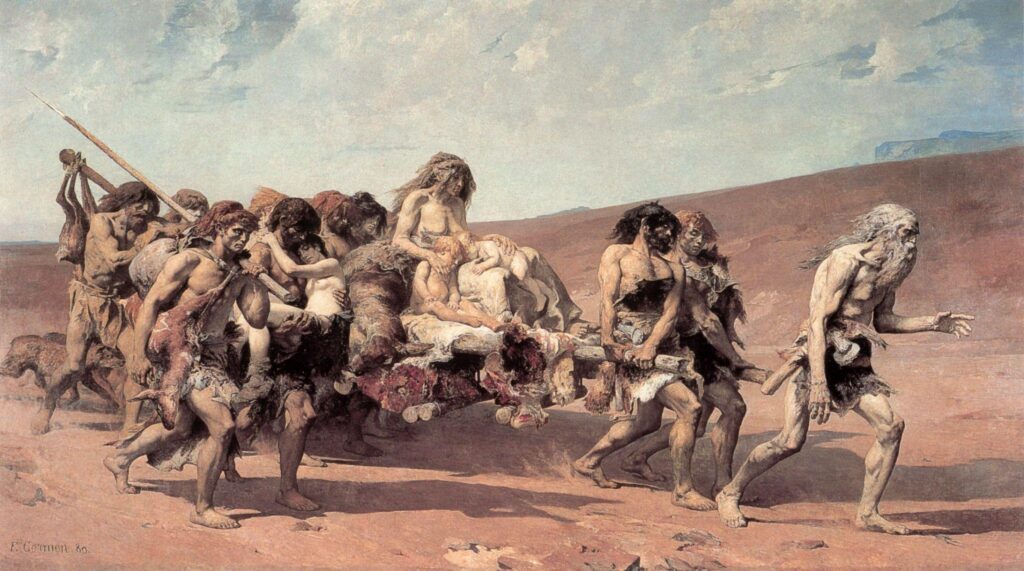
“Cain flying before Jehovah’s Curse” by Fernand Cormon
Cain begets a son, Enoch, which may mean “dedicated,” but can also mean “initiation.” The two meanings are likely linked conceptually, as new beginnings are often ritually consecrated. The city of Enoch is the first city, founded on a brother’s blood, and named after the seed of the murderer. It is interesting to note that there is also an Enoch in the line of Seth, seven generations from Adam (corresponding to Lamech, seventh from Adam in Cain’s line). If the name Enoch is connected to the beginning and dedication of a city, we may speculate that the line of Seth did not achieve their first city until four generations after Cain’s.
Another possibility is that Enoch is the founder of the city and names it after his son Irad, corresponding to Eridu, the ancient antediluvian city of the Sumerian King List. This would require us to take the last instance of the name “Enoch” in Genesis 4:17 as a scribal error, as Wenham and some others seem inclined to do.[6] Either way, I don’t think it significantly changes the thrust of the section.
Cain’s line reads as a veritable who’s who of ancient invention. Jabal develops tents and animal husbandry, Jubal invents the stringed and winded instruments, Tubal-cain develops iron and bronze work. It is striking that Cain’s line produces all of this culture. James Jordan calls this the “Enoch Factor.”[7] The wicked get the good stuff first because they do not wait on God’s timing but grasp for it. The righteous wait for God to build a city (Heb 11:8–16).
2.7. Calling on the Name
While the seed of the serpent propagates through Cain’s evil line, the seed of the woman finds new hope in the birth of Seth. Eve calls him “appointed,” indicating that the seed line now goes through him. The fact that there are no others present to take up leadership of the Adamic clan after Cain leaves the land suggests to us that any men of the clan in Eden followed Cain into Nod and to his city.
Seth’s role as Abel’s replacement is demonstrated through his son Enosh, in whose day “it was begun to call upon the name of YHWH” (Gen 4:26). What was begun? Most translations smooth this verse out by rendering it as “people began to call upon the name of YHWH.” But the text is at once more puzzling and more direct. It was begun—to call on the name of YHWH.
In Genesis, to “call on the name” is a phrase that indicates worship associated with a place. The next time this phrase is used is of Abram in Genesis 13:3 at the place he had built an altar in 12:7–8. Hagar calls on the name of YHWH at the place he spoke to her (16:13–14). Again, Abraham calls on the name of YHWH at the place he planted a tamarisk tree (21:33). And finally YHWH promises to “set his name” in a place (Deut 14:24), which becomes the temple in Jerusalem (2 Chr 6:20).
Calling on the name of YHWH is a liturgical practice which is begun in the days of Enosh. I don’t think we should suppose that this is the first time that anyone ever called on YHWH’s name in this way. In fact, the context of our story includes Cain and Abel (and the Adamic clan) calling on the name before Enosh. Instead, the picture is that this is a resuming—a beginning again—of corporate cultic worship for the first time since Cain slew his fellow brother-priest and, together with the greater part of the Adamic clan, abandoned the gate of Eden on the mountain of God.
2.8. A Tale of Two Cities
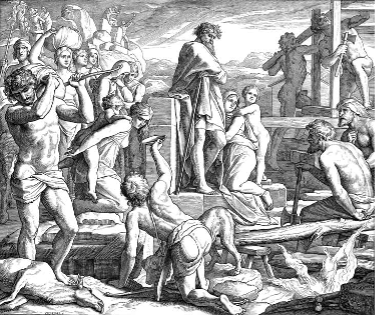
Woodcut for “Die Bibel in Bildern,” 1860. “Kain gründet eine Stadt und benennt sie nach seinem Sohn Henoch.”
Thus, a city also grows up before the gate of Eden around the worship of YHWH. This is the city of Seth, of Enosh, of Enoch, and of Noah, and it stands as a rival to the false city of Cain, which was built around the self-glorification of humanity and the worship of demons.
The thematic thread of the two rival cities begins here and runs throughout the whole Scripture until Babylon and New Jerusalem in the book of Revelation.
Christopher is a Pastoral Intern at Immanuel Reformed Church in Birmingham, AL, where he resides with his wife Ellyn and their four children, Stephen, Eliana, Beata and Claire. He holds a certificate in Biblical, Liturgical, & Cultural Studies from Theopolis Institute. He has been published in the Journal of the Evangelical Theological Society (JETS). Christopher holds a BS in History and Theology from Elmhurst University. He is the executive editor of the Theopolis Blog.
NOTES
[1] I am not convinced by Azevedo’s argument, based on the w [x] qatal construction, that Abel brought his gift before Cain. Joaquim Azevedo, “At the Door of Paradise: A Contextual Interpretation of Gen 4:7” in Cult and Cosmos: Tilting toward a Temple-Centered Theology, ed. L. Michael Morales (Peeters, 2024), 169–170. For this and other exceptions to the anterior preperfect rule Azevedo appeals to, see Paul Joüon and T. Muraoka, A Grammar of Biblical Hebrew (Pontificio Istituto Biblico, 2006), 362–363. For a closer analysis of the supposed rule, see John A. Cook, Time and the Biblical Hebrew Verb: The Expression of Tense, Aspect, and Modality in Biblical Hebrew (Eisenbrauns, 2012), 133–134.
[2] E.g., James Montgomery Boice, Genesis: An Expositional Commentary (Baker Books, 1998), 251.
[3] The idea that Abel’s offering was received in the form of fire from heaven is an ancient one, accepted by Theodotion in his translation of the Pentateuch. See William L. Lane, Hebrews 9–13 (Word, 1991), 334.
[4] L. Michael Morales, “Crouching Demon, Hidden Lamb: Resurrecting an Exegetical Fossil in Genesis 4.7,” The Bible Translator 63, no. 4 (Oct 2012): 185–191.
[5] Jordan, Trees and Thorns, 256.
[6] Wenham, Genesis 1–15, 111.
[7] Jordan, Trees and Thorns, 341.