
The ritual by which someone plagued with skin disease reentered Israel’s camp, complex as it may seem, invites the reader to consider an astonishingly simple truth upon which Jesus will masterfully build: to enter God’s abode, one must enter as a child.
In order to arrive at the ritual’s end, we will discuss the movement, symbolism, and parallelism of the ritual, finishing with its intended fulfillment in Christ.
Movement
Leviticus 13–14 offers a remedy by which one whose body or home is afflicted with a skin disease may return to life as usual. The ritual involves birds, cedar wood, scarlet yarn, hyssop, water, blood, and an earthenware vessel. Though foreign to the modern reader, the seemingly bizarre ritual is riddled with symbolism, remembrance, and truth. To gloss over it without much meditation would be to miss startling truths of profound significance.
A close reading offers a trajectory in regard to the dysfunctions it mentions. The primary issues with which inspecting priests were to concern themselves were the depth and breadth of the malady.1 In doing so, a movement is detected, beginning with the depth of the wound to the hair growing out of it, then to the clothing affected, and then the dysfunction on the walls of one’s home. Movement from inside one’s body, out to the hair, clothing, and finally the edifice surrounding the individual appears to be the trajectory of God.
In this sense, thoughtful readers are meant to discern the dysfunction’s source: the internal. God utilizes this ailment, then, to teach his reader and listener a significant truth: our sickness, most primarily, is not simply skin deep. It’s the mouth of the river versus the outlets with which Yahweh is most concerned. As such, actual healing is meant to remain elusive. Who, after all, can change one’s insides? “Can the Ethiopian change his skin or the leopard change its spots?” (Jer 13:22). It’s here where the ultimate prescription comes to the fore: where internal reformation is needed, rebirth is necessary. If this is so, the reader should expect the ritual assigned to “right” the dysfunction to point toward rebirth. This is exactly the case.
Symbolism
One plagued with skin disease longed to return to the camp (see Ps 42:4). Yahweh intended such a return to be reminiscent of the Exodus by drawing numerous connections from Israel’s liberation from Egypt. In this way, the leper would find immediate association with the Exodus in his return to the camp (see Lev 14:1–20). Consider the abundant ritualistic details assigned and their close alignment with Israel’s Exodus experience:
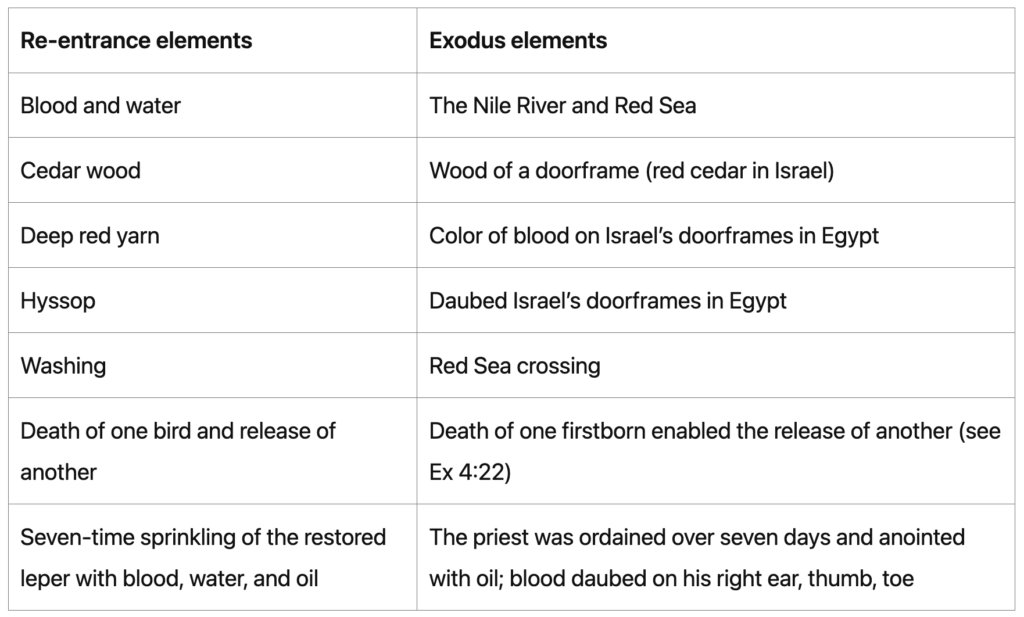
Each aspect of the ritual walks nearly in lock-step with Israel’s exodus experience. Participation in the ritual mirrors an individual passing out of Egypt and into God’s abode. Perhaps one puzzling feature of the reentrance ritual is found in the person having their entire body shaved before entrance is granted. We’ll consider this seemingly bizarre command in the following section.
Parallelism
In one sense, the ritual’s symbols point to the exodus, but beyond that, the reader is meant to ask, “To what did the Exodus symbols point?” It’s here where the concept of rebirth becomes readily apparent. Each symbol of the skin-cleansing ritual, paralleling Exodus’ symbols, ultimately pointed to rebirth:
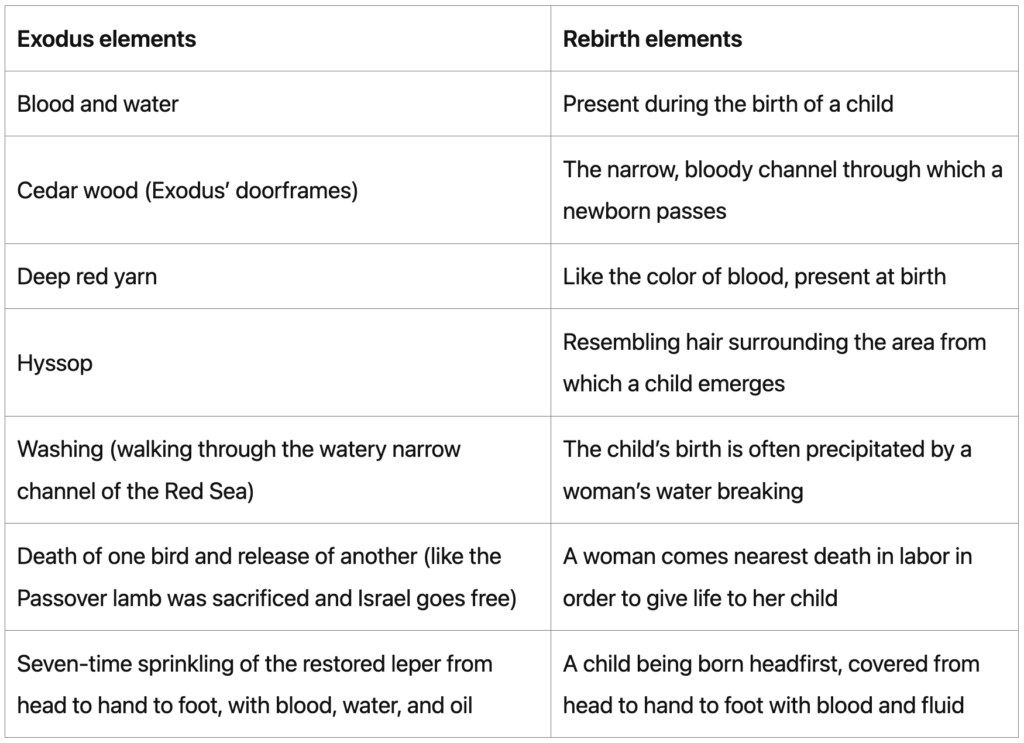
Several additional features of the Exodus also point toward rebirth:
- Infants dominate Exodus’ opening narrative: Israel’s abundant multiplication, the focus on midwives, Pharaoh’s edict of infanticide, and Moses’ birth narrative and protection.
- Israel being shut in their homes during the darkness of the Exodus night may be seen as them being shut within a “womb” behind closed doors (Ex 12:22).
- The Passover sacrifice was instructed to be cooked in way that seems to mirror the fetal position, “its head over its knees, [bunched up] over its stomach” (Ex 12:9).2
- Israel is specifically referred to as Yahweh’s “firstborn” (Ex 4:22).
- The Exodus culminates in Israel being taken to the land of “milk” and “honey,” and most particularly, brought to the high place of Jerusalem, which is later referred to as a nursing mother’s breast (Is 66:10–13).
- Passover was to become a beginning of months for Israel, symbolizing their new birth (Ex 12:2; cf Ezek 16).
- The perhaps puzzling feature of having one’s body entirely shaved begins to become clearer: the individual was to be like those with the least body hair of all humanity—infants.
Stepping back, the cumulative evidence of Israel’s exodus “birth narrative” is staggering.
Fulfillment
It’s here where we must consider Christ’s masterful building upon the rebirth concept: “Truly, truly, I say to you, unless one is born again he cannot see the kingdom of God” (Jn 3:3). The Old Testament’s rich symbolic background prepares us to better understand Jesus’ statement to Nicodemus. Seeking greater clarification, Nicodemus asks, “How can a man be born when he is old? Can he enter a second time into his mother’s womb and be born?” (3:4). To this Jesus responds, “Truly, truly, I say to you, unless one is born of water and the Spirit, he cannot enter the kingdom of God” (3:5). It’s in this statement that we feel the full weight of Jesus’ words.
“Water” and “Spirit” hold a prominent place in Scripture’s opening pages: “The earth was without form and void, and darkness was over the face of the deep. And the Spirit of God was hovering over the face of the waters” (Gen 1:2). Whereas Nicodemus goes back to his initial birth from his mother–Jesus says, effectively, “Go further.” He means for Nicodemus to go back to the time when, in Adam, he was buried beneath the Earth—water atop him and Spirit hovering.
In other words, Nicodemus needs to be a totally new creation with a complete and total rebirth. He needs a new Adam; hence, the coming of Christ. The Apostle John will further develop Jesus’ dialogue with Nicodemus by continually referring to the readers of his letters as “little children” (e.g., 1 Jn 2:1, 12, 28; 3:1, 7, 18; 4:4; 5:21). As a result, what Leviticus pictures in its re-entry ritual is fully realized in Christ: “Truly, I say to you, whoever does not receive the kingdom of God like a child shall not enter it” (Mk 10:15). Jesus is the kingdom of God, and it’s in him that all who enter are reborn.
With Christ as our new Adam this rebirth can be brought about. “Therefore, if anyone is in Christ, he is a new creation. The old has passed away; behold, the new has come” (2 Cor 5:17). As such, not only will children be regularly featured in Jesus’ ministry, but he will also call his followers “Little children” (Jn 13:33; cf. Matt 11:25; 18:1–4; Mk 10:13–15; Lk 18:15–17; Jn 6:9; 21:5). Leviticus’ graphic ritual depicted this rebirth all along.
Ben Lovelady (M.A., MTS) serves as a pastor in northwestern Illinois, where he and his wife live with their six children.
NOTES