
One of James Jordan’s many contributions to biblical theology was applying the “priest, king, prophet” schema to a framework to understand the entire structure of the Old Testament. The Pentateuch is mainly (though not exclusively) concerned with the establishment of the priesthood. After these books come the stories that set up and narrate the kingdom period, and towards the end of the kingdom period there comes an explosion of prophets and prophetic literature. This large scale model is also replicated on numerous smaller scales, including in the life of Abram. In this essay, I will argue Abram functions in all three of these roles during the course of his narrative arc in Genesis.
Abram as Priest
One of these smaller scale occurrences of the priest, king, prophet sequence can be seen in the life of Abram. After the Tower of Babel incident, Abram is called by God out of Ur to travel west to Canaan. When he finally arrives in Canaan, the first place he stops is the city of Shechem and the oak of Moreh, and there he builds an altar (Gen 12:5–7). In Hebrew, the meaning of the word Moreh is “teaching” and may even pun on the Hebrew word for “rain.” Thus, at Shechem we have an altar and a tree associated with teaching or knowledge and an additional wordplay on rain, both of which allude back to the Garden of Eden with the special Tree of Knowledge (2:17) and the lack of rain (2:5). From there, Abram journeys south and pitches his tent between Bethel to the west and Ai to the east, and there too he builds an altar (12:8). Ai in Hebrew means “ruins,” and Bethel means “house of God.” So running from west to east we have the house of God, then Abram’s tent (with another altar that he built), and then ruins further to the east. Later in Genesis 13:18, Abram builds one more altar in Hebron after settling there by the oaks of Mamre.1 In Hebrew, Hebron means “place of alliance,” or “union.”2 Hebron as the place of political alliance comes to the fore with David. After Saul’s death, David is anointed king over a united Israel at Hebron (2 Sam 5:1–5; 2 Chr 11:1–3). These two details of the trees and altar match the details given at Shechem with the tree and altar there lying on a north-south axis.
The overall configuration of this geographic data is a tabernacle structure that lies in the heart of Canaan extended over a large geographic area. There is an altar with a tree associated with knowledge in the north at Shechem3 where the rain comes from and an altar with trees associated with union in the south at Hebron. Between these two cities lies Abram’s tent and another altar with God’s house to the west and ruins to the east. This configuration is both reminiscent of the Garden of Eden and foreshadows the later tabernacle/temple complex. As one comes from the east (as Israel later will do as they come out of Egypt into Canaan—they even stop at Ai), you come from the ruins towards an altar and a two tent assembly, first Abram’s tent and further west the house of God itself.4 As you walk west you will have two groups of trees and two altars on your right toward the north at Shechem and on your left toward the south at Hebron. The two groups of trees recall the two trees in the Garden as well as the tables and altars that will be housed within the tabernacle later. Abram’s travels and building projects throughout the land serve to tie the land together as a multi-city tabernacle complex that establishes worship at the center of the land. The historical details of the story, the city names, and names of the trees are not simply for verisimilitude but are parts of the text meant to aid in its interpretation. The literal historical details invite the allegorical sense.
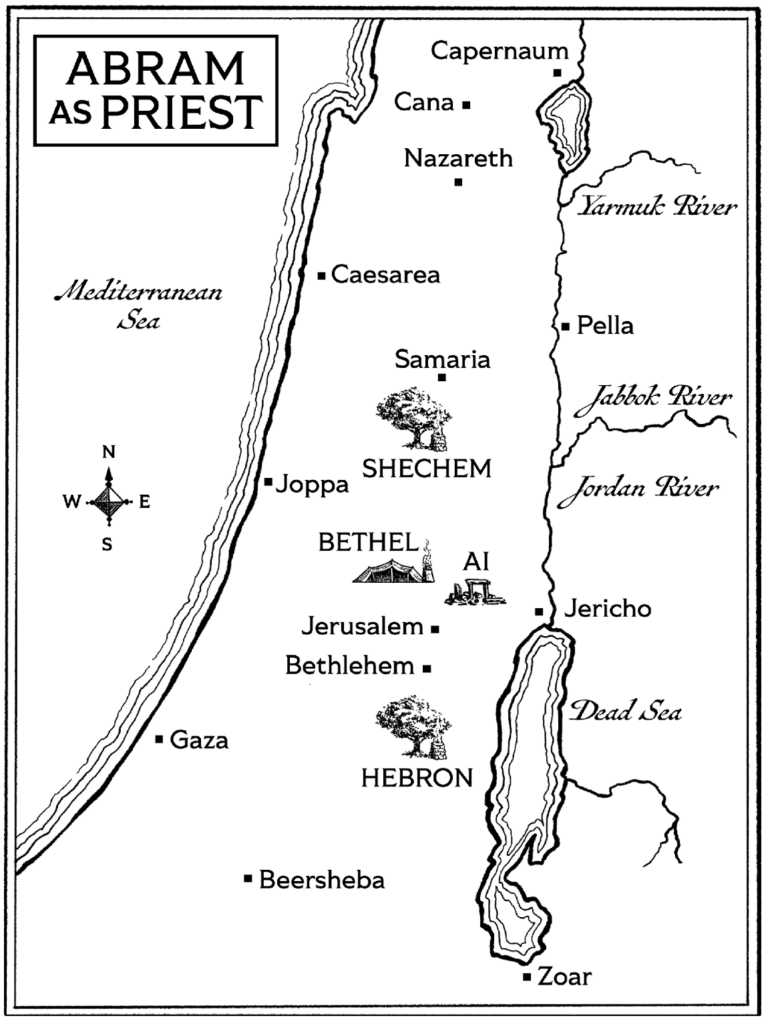
Figure 1: This is a map to help visualize the geographic information expounded for Abram as priest showing the relation of the cities Abram visited. Map created by Caleb Faires.
Abram as King
Genesis 14 recounts a crisis that occurs in the land of Canaan: a world war. Four kings from the east led by Chedorlaomer put down a rebellion in Canaan led by five kings of the region. These five kings were defeated by the four kings from the east, and the cities of Sodom and Gomorrah were completely plundered of people and possessions. Lot was among those taken from Sodom. Abram received word concerning the war and Lot’s fate. Once he learned this news, he immediately mustered an army of 318 fighting men and defeated the four kings from the east! This was no mean feat. This makes Abram in some sense a king, or at least kingly. He defeated the victors of the battle, rescued Lot, and freed all the cities from under the service of Chedorlaomer. Further, Bera, king of Sodom, came out to negotiate with Abram about the people and possessions, but he is a deposed king. He is in no position to negotiate as he fled the battlefield, lost, and had nothing to offer in return. Abram refused to honor him; nevertheless, he gave back the possessions of Sodom to Bera lest he say he made Abram rich. Abram did this because he knew God Most High possessed heaven and earth.
Four aspects of this story point towards Abram being kingly. First, he achieved victory over a previously victorious force. Abram wars against the army of four kings and emerges as the winner of the battle. Moreover, Melchizedek, king of Salem, came out to greet Abram, and Abram pays homage to him. Abram recognizes there is a king greater than he, and it is not the king of Sodom or any of the other kings named in the narrative. This relates back to Abram being a new Adam: just as Adam would have been an eventual king under the High King, so Abram must acknowledge that his kingly role is always subordinate to the greater High King. Abram, then, is second only to Melchizedek, much like Joseph will be de facto king over Egypt, second only to Pharaoh.
Second, Abram has an army of 318 fighting men born in his house. Only kings have armies. Third, Abram has 318 fighting men, and when we add those three digits together (3+1+8) we get the number 12. Thus, Abram is the commander and king of an army that is associated with the number twelve, which foreshadows the future kingdom of twelve tribes ruled over by kings.
Fourth, Abram has three mighty men with him: Aner, Eshcol, and Mamre as allies, who apparently joined their forces with those of Abram to help him fight and win the battle against the four kings of the east. Abram and his three mighty men prefigure king David and his three mighty men.5 This can be seen more clearly when we remember that Matthew 1:1 calls David “the son of Abraham.” God has already promised to make Abram into a great nation; he will later say that kings will come from him (Gen 17:6). The nature of the Abrahamic call is to bring about king and kingdom with the coming of David, and both together point to the coming of Christ the King and his Kingdom.
Abram progresses from a priest who establishes worship and leads the people in worship to a king who fights on behalf of his people to rescue them from foreign oppressors. Abram’s alliances with Aner, Eshcol, and Mamre seem to indicate he is amassing converts as he has been sojourning in the land. It is the king who builds the temple in later biblical history. David and Solomon, two of Israel’s greatest kings, prepare for and construct the temple, one of their greatest individual acts.
Abram as Prophet
Yahweh himself calls Abram a prophet in Genesis 20:7. But where is Abram’s role as prophet demonstrated? A prophet is someone who has access to the heavenly council and can hear the deliberations and decisions made within the council. Sometimes, the prophet can even speak as a member of the council. Abram’s prophetic role can be seen in his intercession for Sodom and Gomorrah. Three members of the divine council, one of which is Yahweh himself (Gen 18:17), have come down to investigate reports against Sodom and Gomorrah. Before they venture into the cities, however, they stop by to visit Abram and eat with him. After eating, they reveal their plans to Abram concerning Sodom and Gomorrah. Upon hearing the words of Yahweh and knowing that Lot was residing in Sodom, Abram with all humility petitions Yahweh to spare the city if a progressively smaller number of righteous people live there. Abram is exercising his prophetic role by advising and petitioning King Yahweh about how to deal with the inhabitants of the city. Ultimately, Sodom and Gomorrah are destroyed and Lot is saved because of Abram’s intercession on his behalf.
Conclusion
Abram, then, progresses from priest to priest-king to priest-king-prophet. This is not meant to ignore or reduce the significance of the many other events in Abram’s life such as the episode with Hagar and Sarah or the binding of Isaac. It is helpful to see that Abram’s life prefigures the life of the nation that will later come from him in fulfillment of God’s promises to him and to his seed. Israel starts from a priestly phase at the Exodus to go out into the wilderness to worship God and build a tabernacle. Moses sets up the whole of the cultic apparatus, and Israel enters its priestly phase. After this, Israel enters into the kingdom period beginning with Saul and David. As the kingdom period begins to crumble and come to a tragic end, we see the emergence of prophets to proclaim God’s message to them. As the fathers, so the sons.
Kelly Kerr works as an OR nurse and devotes most of his free time to Biblical Studies.
- Mamre refers to a person, and the city of Hebron could point to a possible alliance or friendship between Mamre and Abram along the lines of Genesis 12:3. This is likely because Mamre goes with Abram into battle (Gen 14). ↩︎
- Given the cultic overtones with the building of an altar at Hebron and the political alliance enjoined there, this could be a pointer to the more general idea of union and possibly be indicative of the union between, 1) heaven and earth; 2) something pointing to the hypostatic union; 3) marital union; 4) union with Christ; 5) some combination of these. ↩︎
- Shechem in Hebrew means “shoulder” which could possibly indicate, in addition to an Edenic typology and the tabernacle prefigured, a humaniform aspect but in a geographic sense. Thus, the borders of Canaan would match the borders of Eden and the most outer curtain of the tabernacle. Shechem can also mean “early morning”; coupled with the meaning of shoulder, this could be an image of a face like the sun. ↩︎
- If we take Hebrews’ interpretation of the two tents of the tabernacle (the Holy Place and the Most Holy place) as being understood in a temporal sense (Heb 9:8–9), then as long as Abram’s tent is still standing, the way into God’s tent is not yet opened. In some way this seems to point to the temporality of the Abrahamic covenant that will be established and fulfilled in Christ. ↩︎
- David had 37 mighty men total, but there are three who are singled out as being the chief of the mighty men: Josheb-basshebeth, Eleazar, Shammah (2 Sam 23:8–39). ↩︎